How much does a website cost, and what is included?
€299, €500 or several thousand — what actually changes between them, what belongs in every quote, and how to compare two website offers line by line.
Short answer
A website costs €299, €500 or several thousand, and the page count alone does not explain the gap. What moves the number is who plans the structure, who writes the text, which features are needed and who looks after the site once it is live. A quote that says only “website build — €X” cannot be compared with anything, because it never says what is being bought.
Contents · 6 questions
Why is one quote €299 and the next one €1,500?
A small site can be one page doing one job — collecting enquiries for a single service. A bigger project has to separate several services, write the text for each of them, lay out different routes through the site and connect outside systems.
A price only means something next to the list of work it pays for.
These are our own published prices, not a market average. Every figure here is VAT included, and the final price for a project is confirmed in the proposal.
| Project type | Price, VAT included |
|---|---|
| Website | from €299 |
| E-commerce store | from €599 |
| Portal or internal system | from €499 |
What sets the size of the job is not the page count on its own. Whether the text and the photos already exist or have to be created; how many products or services go in; which features and integrations turn out to be needed; whether the site needs a structure built to be found on Google and a plan for its content; how much changing and upkeep it will want after launch — all of that moves the price. So two quotes carrying the identical heading “website build” can hide completely different amounts of work.
What should a website cost include?
A good quote says plainly who plans the structure, who writes the text and puts it in place, which features get built, who tests the forms, and who owns the domain, the code and the accounts once the project ends.
Structure, content, features, launch, ownership and care all belong in writing, inside the quote.
“You supply it”, “we tidy up what you supply” and “we write it from scratch” are three different amounts of work. When two quotes are side by side, it is worth checking which one is actually being sold.
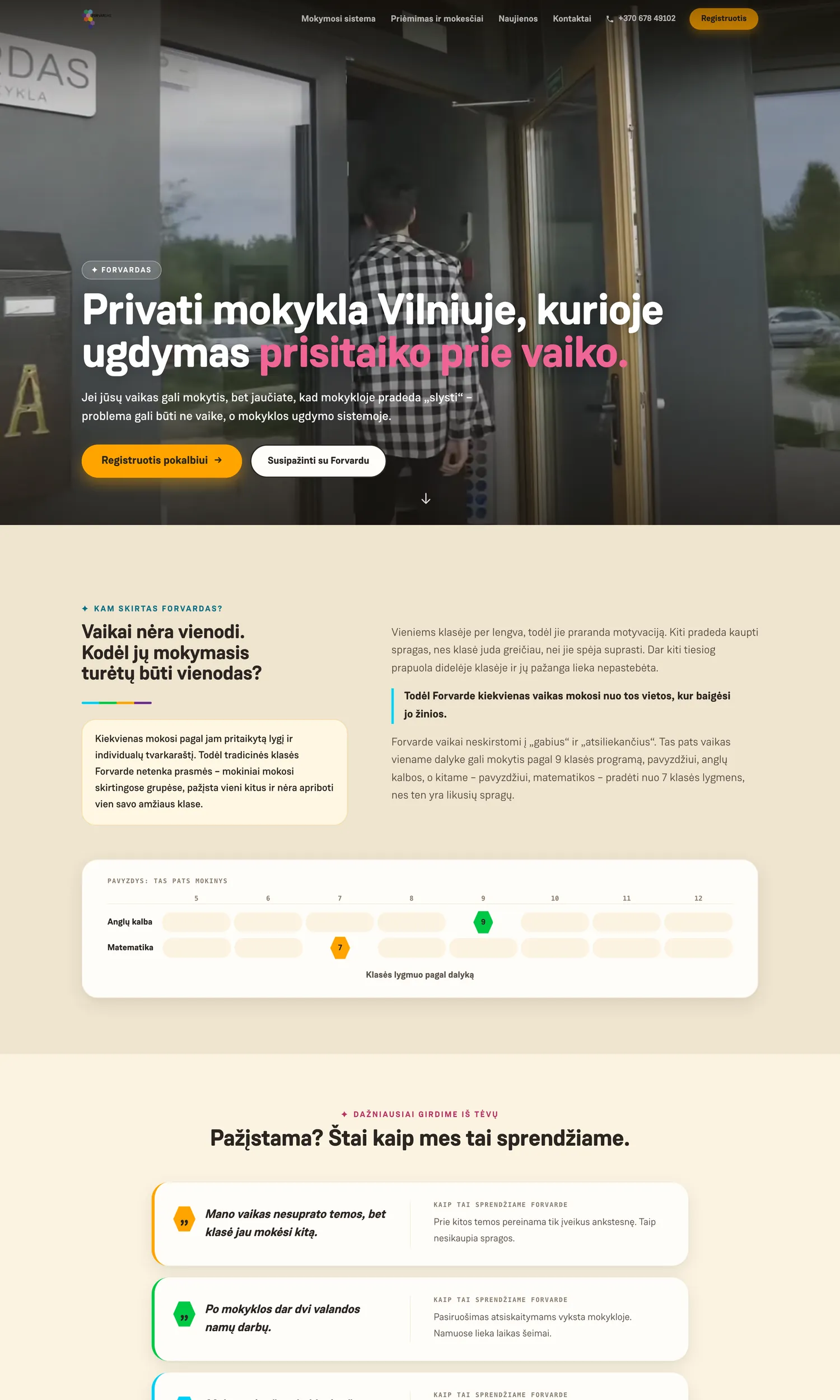
Building the Forvardas site was not a matter of stacking pages. The information had to be split into teaching, pricing and admissions, and a route to an enquiry planned from every page. Work like that belongs on its own line in a quote, not buried under the word “design”.
It is also worth asking who connects the analytics and Google Search Console, and who takes care of hosting, backups and security. Our projects include 3–6 months of care, depending on the size of the site. After that, it is either hosting alone for €10 a month or a care plan with SEO monitoring from €30 a month — or the site can be moved to your own servers, with instructions.
How do you judge technical quality from a quote?
“Mobile friendly” and “fast” should not be promises with no measurement behind them. Google’s current thresholds for a good page experience are LCP (how long the largest visible element takes to appear) under 2.5 seconds, INP (how quickly the page reacts to a tap or a click) under 200 milliseconds, and CLS (how much the layout shifts unexpectedly) under 0.1. At least 75% of visits have to meet them, measured separately on phones and on desktop.
Technical quality belongs in a quote as something measured, tested and handed over with a name against it.
In the T-Mobile case study published on web.dev in 2025, a performance programme improved LCP by 42%, cut overall complaints about the site by 20%, and lifted the visit-to-order rate by 60% among visitors who arrived intending to buy. That is one company’s result rather than a guarantee for anyone else — but it is exactly why speed is worth measuring instead of promising.
T-Mobile’s LCP improvement after a performance programme — one case study’s result, not a promise for every website. Source: web.dev ↗
Ask which tool the site will be checked with before launch, who fixes whatever the check finds, and whether the testing covers real phones, real forms, more than one browser and the things a visitor actually does.
Where does the extra cost usually come from?
Extra work turns up exactly where a question went unanswered before the project started: text or photos that were not ready, another language, a booking system, payments or a CRM (customer relationship management system) to connect, old content to move across, a tighter deadline, or continuing SEO (the work that makes a site easier to find in search).
If a feature was discussed in a meeting but is not written in the quote, treat it as not included.
Extra languages, integrations and other additional work are priced by scope.
It is worth asking for a “not included” section in the quote. It puts the possible extra costs in front of you early, and it protects both sides from holding two different sets of expectations.
How do you compare two website quotes?
Put the same eight questions to both of them. Judge them not on how the promises sound, but on whether the responsibilities and the edges of the work are written down clearly.
If several of these cannot be answered from the document itself, you are not comparing prices — you are comparing two vague promises.
If a working site already exists, a new one is not automatically the better answer. Repairing what you have is sometimes cheaper, so it is worth pricing the repair beside the rebuild before buying either.
- Who plans the structure of the site?
- Who writes the text and puts it in place?
- Is the design made for you, or a template adapted?
- Which features and integrations are included?
- Who tests it, launches it and fixes what breaks?
- Who owns the domain, the code and the accounts?
- What do hosting and care cost after launch?
- What is explicitly not included?
Why does a clear scope matter more than the lowest price?
A website’s price only becomes clear once its scope is. The cheapest quote can be exactly right for a small and very specific job — but it stops being the cheaper option the moment the missing content, features or care have to be bought separately afterwards.
A good quote tells you not only the final figure, but what the site is meant to achieve for the business in return.
Before choosing, write down the pages you want, the content, the features, the integrations and who is responsible for what after launch. Then ask for a fixed quote with the work itemised.