Why not Shopify and not WordPress?
WordPress and Shopify solved a problem that was very real a decade ago. Today, building exactly what a business needs is no longer the hardest or the most expensive route.
Short answer
Not because they are bad platforms — they solved an important problem back when coding everything from scratch was too expensive. Technology has changed since: a custom solution can now be built far faster than a decade ago, and what stays in the system is only what the business actually needs, without the hundreds of features and limits that somebody else might need.
Contents
- A platform used to be the cheaper route. Not necessarily any more
- Being universal always has its price
- What about managing the content?
- Less code that is not needed — less to maintain
- When a business is not standard, the gap grows wider
- Is a custom solution always better?
- So why not Shopify and not WordPress?
A platform used to be the cheaper route. Not necessarily any more
Five to ten years ago we would still have suggested choosing between WordPress and Shopify. At the time that was often the most practical answer: building a website or an online store individually was expensive, it took a long time, and a ready-made platform already carried most of the functionality needed.
Today the situation is different.
Modern development technologies make it possible to build a complete website, online store or system from scratch in a relatively short time, shaped around one specific business. With its own design, its own admin, the functionality it needs and its own business logic.
And it no longer takes a large development team — what once required many people and months of work can now be built by a team of a few.
So the first question is less and less “WordPress or Shopify?” and more and more “what does this system actually have to do?”
Being universal always has its price
A family car can be comfortable in the city, get you to the countryside and fit everyone in. But on a track it will not outrun a car built for that track.
Software works on a similar principle. The strength of WordPress and Shopify is that they are universal: WordPress has to suit a blog, a law firm, a restaurant, a news portal and an online store, while Shopify has to suit both a shop with a handful of products and an international brand with thousands.
For that to be possible, a platform cannot be built for one specific purpose. It has to carry features, settings and options that one business will need and another never will. When the standard options are not enough, themes, plugins, apps and extra integrations appear.
A custom solution starts from the other end. First you work out how the business runs and what it is trying to achieve. What information does the client need? What has to be managed in the admin? How does an order happen? Where should an enquiry go? Do different clients see different prices? Is an integration needed with a CRM, accounting, a warehouse or another system already in use?
Only then is the technology built. If six fields are needed, six are built. If there is no blog, there are no blog features. If there are three customer pricing levels, the system has three pricing levels. If the ordering process is nothing like a normal online store, there is no reason to force it into the standard “cart → delivery → payment” model.
A business should not have to adapt to its system. The system is built around the business.
What about managing the content?
This is probably the most common reason WordPress or Shopify gets chosen. And it is completely understandable.
A website that needs a developer for every change of text, image or price is not a good custom solution.
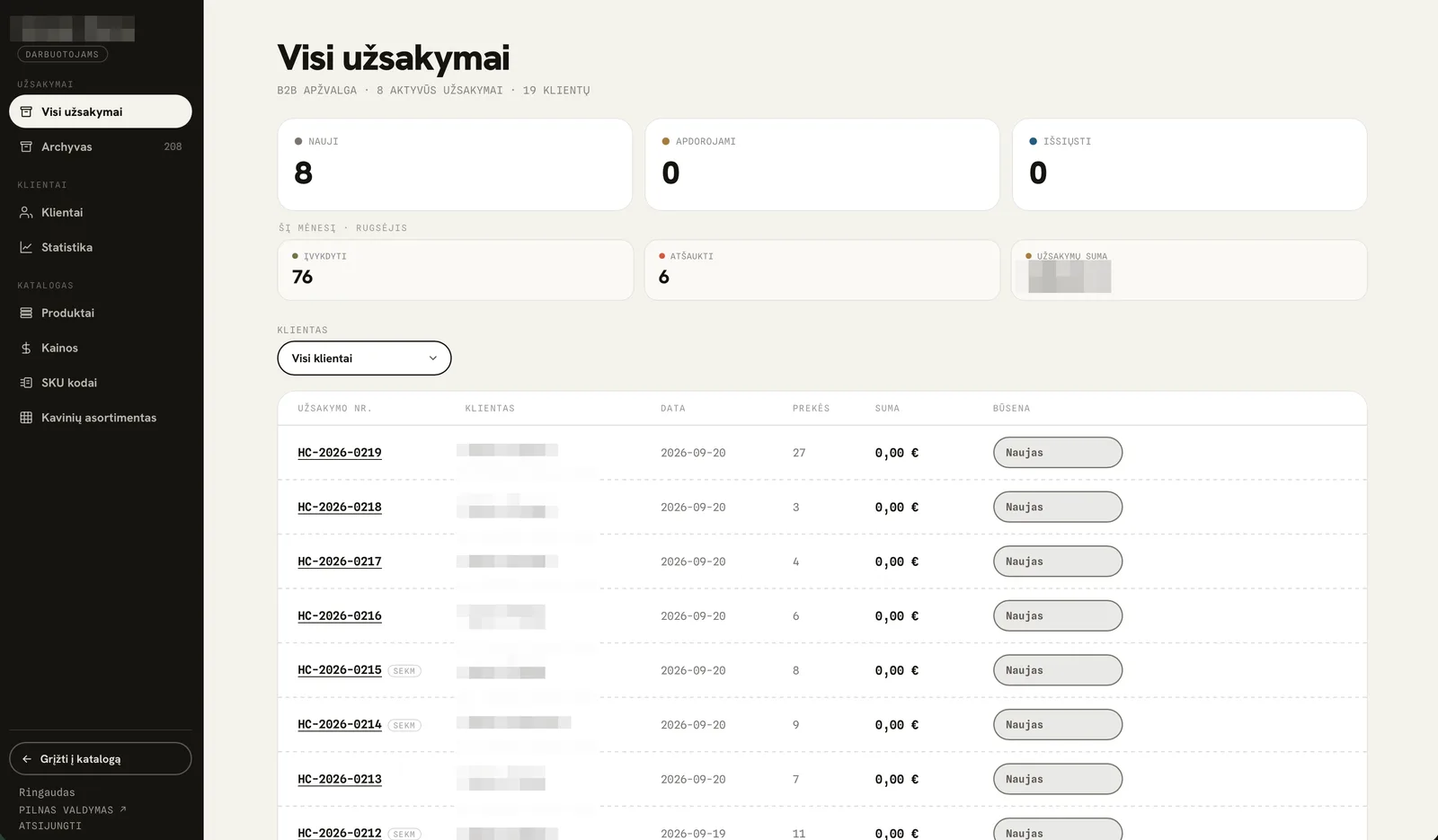
But a custom-built website does not mean the content cannot be managed independently. Quite the opposite — we build the admin as individually as the site itself. And this is where one of the biggest advantages of a custom solution appears.
- Services
- Team
- Articles
- Enquiries
- Products
- Orders
- Customers
- Discounts
- Customers
- Individual prices
- Orders
- Invoices
The admin holds only what is actually used. Fields and sections are named the way the business names them. There is no hunting through menus or plugin settings for the option you want.
So custom content management can be not harder, but considerably simpler.
Not because it has more features. Because it has none of the unnecessary ones.
Less code that is not needed — less to maintain
The WordPress core itself is maintained well. The problem usually appears around it: a real website is not only WordPress, but also a theme, plugins and the dependencies between them.
In 2025, 11,334 new security vulnerabilities were registered in the WordPress ecosystem. 91% of them were found in plugins, while the WordPress core itself had only six low-priority vulnerabilities, according to Patchstack data.
of the WordPress ecosystem’s 2025 security vulnerabilities were found in plugins, not in the core itself. Source: patchstack.com ↗
That applies to speed, to security and to long-term maintenance alike: what is not there does not need updating or fixing.
Of course, custom code is not automatically secure simply because it is custom. That is why we keep maintaining the websites and systems we build, updating the technologies and integrations they use.
So far, not one website, store or system we have built and maintain has been breached.
When a business is not standard, the gap grows wider
On a simple brochure site the difference between platforms is barely noticeable. It is far clearer when a system has to reproduce a real business process.
For example, a B2B client logs in, sees only the products meant for them and their own prices, repeats a previous order with one click, and the order data is passed automatically to the other systems the business uses.
In a custom solution that is one process. On a universal platform you have to work out which part of it the platform already handles, which part will need a plugin or an app, what can be integrated and what will have to bend to the platform’s limits.
Sometimes a website is just a website. And sometimes it can replace a spreadsheet, a chain of emails, orders typed in by hand or several actions staff repeat every day. Then what it is built on stops being the point.
What matters is how much work it takes off the business.
Is a custom solution always better?
Not everyone needs a custom solution.
If a store has to be live in a few days, there is no need for custom design or custom processes, and the point is simply to start selling as soon as possible, Shopify is built for exactly that.
WordPress also has an enormous ecosystem and can be a rational choice when there is already WordPress infrastructure, a team that works with it, or a specific need for an existing WordPress solution.
But when a project is built from scratch, the argument that “you need WordPress or Shopify, otherwise you will not be able to manage the site yourself” no longer holds.
The same can be built — the admin, the products, the orders, the user access, the payments and the integrations — only for that one business.
Custom code also does not mean depending on a single developer. A project is code, a database and a documented structure. It can be handed to another developer, moved to different infrastructure and extended further.
The work with code is changing too. Modern AI coding tools can already help to understand an existing project, find the right place in the code, suggest changes or carry them out. That lowers the barrier to working with a custom-built system even further. So custom today does not have to mean “depending for life on the person who built it”. On the contrary — the project can belong to the business.
So why not Shopify and not WordPress?
Not because they are bad platforms. They solved a very real problem: they made it possible to build complex websites and online stores quickly and relatively cheaply at a time when coding all of it from scratch was too expensive.
But the technology changed. Modern frameworks, cloud infrastructure, automation and AI coding tools speed up software development every day. The same technological progress that helps improve those huge platforms is now available for building a single custom project.
Only in a custom project there is no universal layer sitting between the business and the technology. Instead of waiting for a platform to offer the feature you need, it can be built exactly where it is needed.
So building a custom solution is no longer as slow or as expensive as it was a decade ago. You do not have to pick which universal platform will adapt best to a business. You can build a system around how that business actually works.
People will go on choosing Shopify. They will go on choosing WordPress. But as technology moves forward, there are fewer and fewer reasons to take hundreds of features, settings and limits along with a website simply because somebody else might need them.